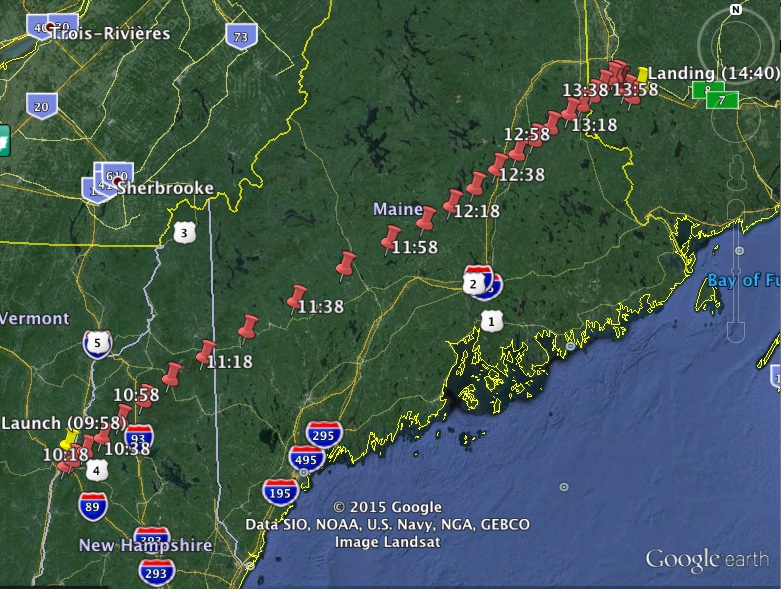
Here are minutes of our telecon Thursday July 21, apologies for the delay! -- please just reply with (or let me know) any corrections -- thanks! :
Attendees: Arnold Gaertner (NRC) and me
The 7 boxes of ALTAIR stuff that were shipped across the country (driven by me from Hanover NH to Fredericton NB, and then UPS shipped them here to Victoria) just arrived today (Wed. Aug. 3), and we'll now begin to assemble stuff here over the upcoming weeks. The boxes contain stuff for ALTAIR gondolas and payloads; balloons and launch equipment; ground station antennas, transceivers, and cables; and assembly and lab equipment. General plan here is to prepare for dummy payload drop tests this fall, and also to start assembling a real payload for flights this coming spring (as well as of course software and other necessary work).
On Sunday July 24, just outside Fredericton, together with my former PhD student (on the ATLAS experiment at the LHC) Dr. Eric Ouellette (now an actuary at a major Canadian firm), we attempted to recover the SPOT Trace that is in a tree in the woods in NB (about a km from a small lake called Charlie Lake):
https://particle.phys.uvic.ca/~jalbert/ALTAIRPartyBalloonLaunchTestForNATOApp_Dec2015/BareSPOTTrace18Dec2015-FlightPath.jpg
however the summer vegetation was very thick (very different than when I made a similar trip to find it in December!) and this time we were unable to find it in order to recover it. So it's still up there -- however I have another SPOT Trace, so it is not urgent to find it.
The motorized, propelled version of a dummy payload for flight tests via drops from a tethered balloon is assembled and functioning! -- a video can be found at
https://particle.phys.uvic.ca/~jalbert/MotorAndPropTests/MotorizedDummyPayload_6jul16.MOV
and some photos of the assembly are attached in the links at the bottom of this message. The propulsion and axle rotation are functioning, however I still do need to make the parachute/parafoil cutdown system for it (basically per Yorke's ALTAIR cutdown and parafoil steering system design), which we will do over the next weeks here in Victoria.
The hardware for the pre- and post-flight photometry cross-check device -- the 12" aluminum sphere (a photo of it is attached in a link at the bottom of this message, http://www.sharpeproducts.com/store/aluminum-12-dia-sphere) as well as the white "Avian-B" Lambertian reflective paint for its interior -- is currently back in the machine shop here at UVic for machining and painting. This will be a field photometry check device to, in the field immediately before launch, and right after recovery, cross-check photometry information from the ALTAIR gondola (to an accuracy and precision of about 1% or so. Note that photometry checks which will be more precise than that will be done in the lab, most precisely at NRC, and/or NIST -- however we want to have the ability to do quick cross-checks in the field immediately before and after flight.) Some renderings (of the upcoming device) are also attached in the attachment links at the bottom of the message. UVic machinists say that they will have it ready in approximately a month or two.
We also now have the hardware for (a completely separate) survey-tripod-mounted device to cross-check yaw-pitch-roll information from the gondola (e.g., on days before/after flights) -- a photo of this hardware is in a link at the bottom. That hardware includes both the survey tripod (http://www.cpotools.com/cst-berger-60-alwi20-o-aluminum-tripod-with-quick-release--orange-/cstn60-alwi20-o,default,pd.html), two adjustable angle mounts (http://www.thorlabs.com/thorproduct.cfm?partnumber=AP180), and a rotation mount (https://www.thorlabs.com/thorproduct.cfm?partnumber=RP01). We'll make the fittings to attach the adjustable angle mounts and rotation mount to the tripod, and (temporarily pre- or post-flight) to the payload, here in Victoria.
We're currently revising the draft initial contractual agreement from our colleagues at Globalstar Canada regarding 2 initial SPOT Trace devices (and their service plans) for the educational side-project for the upcoming NATO SPS application, in which classrooms in elementary and high schools could launch company-donated SPOT Traces using party balloons (or a more environmentally-friendly version thereof), and track them to learn more about winds at different levels in Earth's atmosphere.
Karun is working with a sample microcontroller board (with Microchip PIC18F87J50 microcontroller) from the UVic electronics shop, to use for testing motor control for an ALTAIR motor and propulsion control microcontroller board we will be designing this term. He has now gotten the pulse width modulation code for it up and running -- video at
https://particle.phys.uvic.ca/~jalbert/MotorAndPropTests/IMG_2136.MOV
and Karun has also solved the problem of simultaneous control of two propulsion motors, and of controlling a servo as well as propulsion motors. He's now working on monitoring the input from the on-chip A/D converters (which will be monitoring temperatures, motor RPM rates, and current flow). We just purchased a second little PIC microcontroller board: http://www.digikey.ca/product-search/en/programmers-development-systems/accessories/2621524?k=PIC18F97J94 with a more advanced version of the PIC18F87J50 -- the PIC18F97J94 -- so that we can test out that new one as well before we make our custom board with it. We also have the beginnings of a little mechanical test rig, the internals and externals of which can be found in the four attached photos, and in the following movie showing the lightweight but strong servo gearbox for rotation of the propulsion support axle:
https://particle.phys.uvic.ca/~jalbert/MotorAndPropTests/IMG_2145.MOV
and now the setup is all together, and just waiting for monitoring sensors (motor RPM, current, temperature) and microcontroller control:
https://particle.phys.uvic.ca/~jalbert/MotorAndPropTests/IMG_2198.MOV
As a backup / cross-check, we are simultaneously trying an Arduino-based control system (which uses an Atmel ATMega 2560 microcontroller). When within ALTAIR, the motor and propulsion control microcontroller board will logic interface with Yorke's main board (in a similar way to how the present cutdown-motor control board interfaces with the main board. Separate propulsion battery will of course be carried.) A screenshot of a propulsion system slow-control and monitoring program which I've been working on is attached.
Regarding simulation of the above, James Hartwick (senior undergrad here at UVic, who has done an enormous amount for ALTAIR, including much of the current projectaltair.org website, light source work, etc) has now written an ALTAIR flight propulsion control and simulation program, which includes GFS (global forecast system) file input, for both forecast and real-time information of winds at all points in Earth's atmosphere. We'll have plots, images, and data from his software coming up very soon. I am developing a visualization interface for this control and simulation program, which will be based on Google Earth, but display the real-time (as well as forecasted) winds within Google Earth in a way that is somewhat similar to this site:
https://earth.nullschool.net
I'm working on a streak-vector display of winds within Google Earth that is reminiscent of the above site, and you can see a first attempt (with a single streak) here:
https://particle.phys.uvic.ca/~jalbert/GoogleEarthWindMovie.mov
and an attempt with multiple streaks here:
https://particle.phys.uvic.ca/~jalbert/GoogleEarthMultiStreakWindMovie.mov
Google Earth, while wonderful, is not open source, and does not presently have a programming interface (it can only be scripted with .kml files, which cannot, for example, loop over multiple lines of code in the way a programming interface could). I am thus working on versions of the above using NASA World Wind, which is an open source and programmable Google Earth alternative. I have a start on that which can be seen here:
https://particle.phys.uvic.ca/~jalbert/NASAWorldWindWithWindsTest_20jul16.mov
Houman will send Cordell and/or us updated sections of his master's thesis soon -- that information will be extremely useful to us going forward. Also, Susana and Nathan, it would be very helpful for us all to get the JHU students' final writeup when you have a chance.
Our next grant application will be a NATO "Science for Peace and Security" application, together with Australian colleague partners.
That's all I remember, please send things that I forgot. Next telecon tomorrow (Aug. 4), at 6 pm Eastern time.
 cheers, thanks very much all!
 justin
On Thu, 21 Jul 2016 01:36:55 GMT, Justin Albert wrote:
> Hi!
>
> Telecon tomorrow (July 21 in North America, July 22 in Australia) at the
> new regular time: 6:00 pm Eastern (3:00 pm Pacific, noon Hawaii,
> midnight European, 8 am Eastern Australia). Discussion items include:
> flight and telescope plans and tests (including planning for flight
> testing outside of New Hampshire); light sources and light source
> modelling; goniometric and pre- and post-flight calibration; propulsion
> work; nanosat bus and payload solid models; computing/website; grant
> applications; and recap of schedules.
>
>  Here's how to connect:
>
>  1) Open Skype on your computer (note that of course, you should first install Skype, http://www.skype.com , on your machine if you haven't already).
>  2) In the "Contacts" menu, add me ( jalbertuvic ) as a contact, if you haven't already.
>  3) Just wait for me to Skype-call you at the usual time (4 pm Eastern, 1 pm Pacific).
>  4) If there is any trouble, or if you don't get a Skype-call for some reason and would like to join, just send me an e-mail (jalbert@uvic.ca).
>
> Here's the tentative agenda:
>
>  I)   Flight and telescope plans and tests, including planning for operations outside of New Hampshire
>  II)  Diffused light source, and its modelling, pre- and post-flight calibration, and goniometric calibrations
>  III) Propulsion & motor control work, and the new motorized dummy payload
>  IV)  Nanosat solid models & Houman's thesis
>  V)   Computing/website
>  VI)  Grant applications
>  VII) AOB
>
>  Talk to you all tomorrow, thanks!
>  justin
Attachments:
      http://projectaltair.org/HyperNews/get/AUX/2016/07/07/13.52-96622-dDummyPayload1_6jul16.jpg
      http://projectaltair.org/HyperNews/get/AUX/2016/07/07/13.52-91301-dDummyPayload3_6jul16.jpg
      http://projectaltair.org/HyperNews/get/AUX/2016/07/07/13.52-22712-dDummyPayload5_6jul16.jpg
      http://projectaltair.org/HyperNews/get/AUX/2016/05/22/18.23-24702-12inAlSphere.jpg
      http://projectaltair.org/HyperNews/get/AUX/2016/04/06/16.53-58615-SideView.pdf
      http://projectaltair.org/HyperNews/get/AUX/2016/04/06/16.53-48539-TopView.pdf
      http://projectaltair.org/HyperNews/get/AUX/2016/05/22/18.23-93827-tch-roll_calibTripod2.jpg
      http://projectaltair.org/HyperNews/get/AUX/2016/06/08/18.04-17780-asseminternal3jun16.jpg
      http://projectaltair.org/HyperNews/get/AUX/2016/06/08/18.04-71442-assemexternal3jun16.jpg
      http://projectaltair.org/HyperNews/get/AUX/2016/05/04/17.45-92797-opulsionMonitoringNew.jpg